EPCs for Non-Domestic Property: The Latest Changes
The UK Government has announced a significant change to its proposed approach to energy efficiency standards for non-domestic property in England and Wales. For owners, investors and occupiers of commercial property, this is one of the most important developments in the EPC regime since the introduction of MEES. Rebecca Millard, Senior Associate in our Commercial Property Team explains...


The UK Government has announced a significant change to its proposed approach to energy efficiency standards for non-domestic property in England and Wales. Following its interim response published on 18 June 2026, the Government has confirmed that it intends to adopt a more targeted approach to Minimum Energy Efficiency Standards (MEES), focusing on larger commercial buildings rather than imposing higher standards across the entire market.
For owners, investors and occupiers of commercial property, this is one of the most important developments in the EPC regime since the introduction of MEES.
Since 1 April 2023, landlords have generally been prohibited from letting or continuing to let non-domestic property with an EPC rating below E unless a valid exemption applies. Existing exemptions, including the seven-year payback test, remain available in appropriate circumstances.
Until recently, the industry had been expecting a gradual uplift to EPC C by 2027 and EPC B by 2030 across most commercial rented property. However, the Government has now changed course. The Government's latest announcement confirms its intention to:
- Require privately rented non-domestic buildings larger than 1,000 square metres to achieve EPC B by 2031, where cost-effective.
- Retain the current EPC E minimum standard for buildings below 1,000 square metres.
- Abandon the previously proposed EPC C milestone for 2027.
- Retain existing exemptions and flexibility mechanisms, including the seven-year payback test.
- Introduce the changes through future secondary legislation, meaning the proposals are not yet law.
The Government has stated that this approach is intended to target the buildings where the greatest energy savings can be achieved whilst reducing the burden on smaller landlords and businesses. It estimates that tenants in larger premises could save up to £360 million annually on energy bills by 2031.
The effect on the commercial community
While the proposed EPC B requirement has been retained for larger rented buildings, smaller properties will continue to be subject to the existing EPC E standard. As a result, the impact will vary significantly depending on whether you are a landlord, investor or occupier, and the size and type of property involved
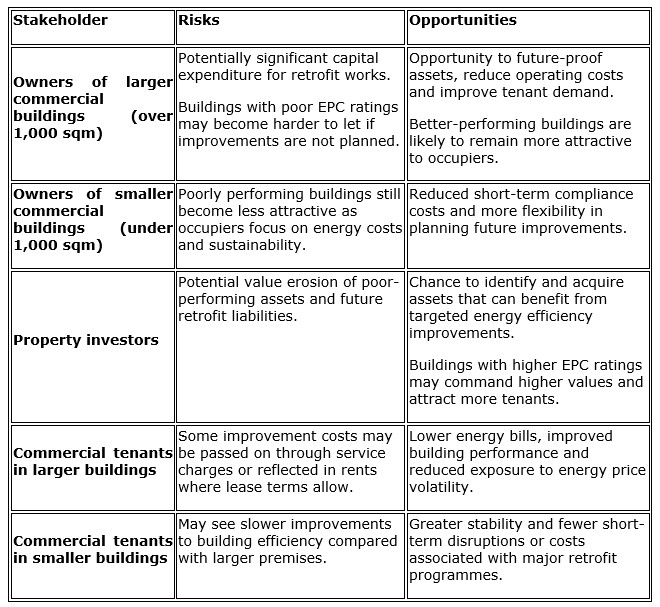
While 2031 may appear some distance away, many buildings currently rated D, E, F or G will require substantial investment to achieve EPCB. Improvements may include:
- Upgrading heating and cooling systems.
- Installing LED lighting and smart controls.
- Improving insulation and building fabric.
- Replacing older plant and equipment.
- Introducing renewable energy technologies.
Property owners and landlords should begin reviewing their portfolios now to identify potential compliance risks and budget for future capital expenditure incorporating the above style works and otherwise to consider and register applicable exemptions.
Investors acquiring larger commercial assets should continue to undertake detailed EPC and carbon performance due diligence. A building that technically complies today with EPC E may still require significant expenditure to remain attractive in the future marketplace. The latest announcement may also create a widening value differential between modern, energy-efficient buildings and older stock requiring extensive upgrades.
The Government's modelling suggests substantial savings for occupiers of larger buildings as a result of improved efficiency standards. However, tenants should be aware that landlords may seek to recover some upgrade costs through service charges, rent reviews or refurbishment programmes where lease terms permit. When negotiating leases, tenants may increasingly focus on:
- EPC obligations.
- Green lease provisions.
- Data sharing relating to energy consumption.
- Rights of access for improvement works.
- Service charge recovery provisions.
What Happens Next?
The Government's announcement is currently an interim response rather than final legislation. The proposed EPC B requirement for larger buildings will only take effect if secondary legislation is successfully passed through Parliament. Further guidance is expected regarding implementation and the operation of the proposed 1,000 square metre threshold. Nevertheless, the direction of travel remains clear. Energy performance will continue to be a key consideration in the commercial property market, and stakeholders should not assume that regulatory expectations have disappeared merely because deadlines have been adjusted.
How can Leathes Prior help?
Our Commercial Property Team are here to help clients manage compliance risks, protect asset value and negotiate appropriate contractual arrangements, be this through drafting and negotiating lease provisions dealing with energy efficiency works, advising on asset management strategies or negotiating limits on service charge recovery for upgrades meaning you can make informed decisions, avoid costly disputes and unexpected expenditure as the regulatory framework continues to evolve. To discuss anything raised in this article, please contact our Commercial Property Team via 01603 610911 or info@leathesprior.co.uk.
















%20copy.jpg)